Showing posts with label joanne chang. Show all posts

10.05.2013

Concord Grape Pie with Leaf Lard Crust Will Do That


When I put this pie into the oven I thought, this has to be the goddamned ugliest thing I’ve ever seen.  Pie making is typically not a graceful process.  (At least for me, you may be brilliant at it.) I usually vow to never make another as I close the oven door.

And this adventure was even more tenuous as it involved lard, and its rendering.  Leaf lard, though poetically named, is the fat around the kidney of a pig.  It’s wonderful for pastry because it doesn’t taste too piggy (or renal-y) and makes things incredibly tender.  But you need to melt it down to separate out the chewy parts.  

You get a beautiful golden liquid, which turns snow-white when chilled.  And in the liquid you have chicharron-like morsels bobbing about, which ultimately get strained.  It’s actually not a terribly difficult process. Though, if you spill some when hot, you’ll be cleaning up white waxy bits for days. 

Still with me?  Let’s get back to pie.  I first heard of grape pie during a weekend trip to the Finger Lakes a few years ago.  It was advertised on a small roadside sign, but unfortunately the shop—which looked suspiciously like the baker’s actual house—was closed.  I still think about it every October. 

Well, the 1st was my birthday.  And now that I am in my 31st year, I thought I would wait no longer for grape pie.  

Good thing.  It’s a beautiful fall dessert.  My friend Deb said it reminded her of childhood, something about it she just couldn’t place.  Then she ate two pieces. 

And I think that’s a pretty appropriate description.  It’s slightly unusual, but balanced by a familiar memory of Welch's.  When cooked, it resembles blueberry pie, until you notice the inky purple color.  Plus the crust is insanely tender and flaky. (Lard will do that.)

So it’s solidified its place as an annual autumn pie, despite being a tad fussy.  Because after it’s all over, and bubbling hot out of the oven, and gorgeously golden brown, you forget what a bitch it is to work with. (Good pie will do that.)

Concord Grape Pie with Leaf Lard Crust

Ingredients:

for the pie crust

245 grams (1¾ cups) all-purpose flour
1 tbsp sugar
1 tsp kosher salt
110 grams (1 stick) of butter, cold
118 grams (about ½ cup) leaf lard, cold
2 egg yolks
3 tbsp whole milk
1 egg (for the top)
demerara sugar (for the top)

for the filling

2 pounds concord grapes
scant ½ cup sugar
¼ tsp cinnamon
4 to 5 tbsp cornstarch (use the larger amount if the grapes are really liquid-y)
pinch of salt

Instructions:

In a stand mixer with the paddle attachment, mix together the flour, sugar, and salt (for the crust) until combined (about 10 to 15 seconds).  Cut the butter into 6 pieces and the leaf lard into 1-inch chunks.  Scatter the butter and lard over the flour and mix on low speed until clumps the size of walnuts form (about a minute).

In a small bowl, whisk together the egg yolks and milk; add to the mixture on low speed until the dough barely comes together (about 30 seconds); it will look rough and will not be well-formed.

Dump the dough onto an unfloured surface and then gather it into a mound.  Using the palm of your hand, push down and smear out the mound, starting at the top; work around clockwise until the fat is smeared into the dough and the dough comes together (this usually takes between 1 to 2 rounds, or 4 to 8 total smears).

Gather up the dough and wrap tightly in plastic wrap; chill for at least 4 hours.

When you are ready to make the filling, remove the dough from the fridge (to let it warm up so it can be rolled).

Over a medium bowl, remove the skin of each grape by pinching it with your fingers (it will come off easily); place the skins in the medium bowl and the fleshy green pulp into a medium saucepan.  Continue until all the grapes have been separated into pulp and flesh.  Set the skins aside and cook the pulp for 5 to 10 minutes over medium heat until the seeds separate from the pulp (this will be easy to see).

Strain the pulp over the bowl with the skins, pressing down to extract all the liquid and pulp (you’ll actually have quite a bit).  Discard the seeds; set the grape mixture aside to cool.  Meanwhile, in a small bowl, combine the sugar, cinnamon, cornstarch, and salt; set aside.

Preheat the oven to 450 degrees.  Get out an 8 or 9-inch pie pan.  Divide the dough into 2 equal pieces.  Generously flour your work surface, your rolling pin, and 1 half of the dough (the dough is much easier to handle well-floured). 

Roll out the dough until it’s about 12 inches in diameter, pushing the pin out and gently rotating the dough as you go.  Loosely roll up the dough around the rolling pin and then gently onto your pie pan.  Ease the dough into the pie pan and leave about a ½ inch overhang around the edges.  (If it rips a bit, simply piece it back together.) Stick the pie pan in the fridge.

Place the sugar mixture into the saucepan with the grapes and stir to combine.  In a small bowl, beat the egg and get out a pastry brush.  Flour your work surface again and roll out the second piece of dough in the same manner as the first.

Take the pie pan out of the fridge and pour in the grape mixture (if you are using an 8-inch pan you may have a little grape mixture left over, depending on the depth of your pan, so just pay attention as you are pouring so you don’t overfill).  Wrap your second piece of dough around your rolling pin and over the pie.  Crimp the edges together and cut a few vents in the center.  Brush the top with beaten egg and generously dust with demerara.

Place on a cookie sheet and bake for 15 minutes then lower the temperature to 350 degrees and bake for another 40 to 50 minutes.  Along the way, check the pie to make sure the edges aren’t getting too dark, if they are cover them with foil (I had to do this after about 20 or 25 minutes, and actually turned my oven down to 300 for about 15 minutes, but I think my new oven runs a little warm).  Bake until the crust is golden brown and the fruit is bubbling.  Cool before serving.

Serves 8

Notes:
-Here’s some information on leaf lard (why it’s wonderful and how to render it). I found mine from the farmers’ market, though a butcher shop may have some they’ve already rendered. 

-The grape filling will be mostly liquid, but will gel as it bakes. 

-In my research, leaf lard crusts had a ratio of 60% butter to 40% lard.  However, laziness—and an abundance of lard—prevailed for me.  (I didn’t want to cut into another stick of butter and so I went 50-50.) I don’t think I’ll look back.

-Be ready to use a little extra flour, if necessary.  The framework for this piecrust is from Joanne Chang.  It uses slightly more fat than many other recipes, which means it’s incredibly tender, but a little harder to work with. 

11.28.2012

Pecan Pie and the Hunters


Three little letters. P-I-E.  But they can strike fear.  There is the prospect of shrinking crusts (!), tough pastry (!), and gummy dough (!) for one.  Add a pinch of “meeting the boyfriend’s family for the first time” and you have yourself a down-home recipe for a thanksgiving disaster.


That is, if you don’t have the right recipe.  And if the family doesn’t happen to be one hundred and ten percent wonderful.  For me, both turned out to be quite lovely.  I was lucky enough to spend five days a few hours north of Portland with some very special people and enough food to feed a forest. 

Of course, there was the dinner of  turkey with two kinds of stuffing, sliced cranberry sauce, and mashed potatoes dug from the field next door.  But there was also venison sauerbraten.  Lasagna.  Pistachio cake.  Cheese.  Lots of cheese.  Tangerine poppy seed bread.  Red wine.  Bourbon.  And beer.  Lots of beer. 

Plus a whole roasted porchetta-style pig with a cider reduction.  Coriander beets.  Rosemary roasted potatoes.  And cooked down kale greens.  To name a few.

In the early morning hours, bright orange hats and warm coats went out in search of deer.  And when the sun went down, the hunters came back in search of beer.  Cocktail hour started at 4:30 pm sharp.  Dinner for twelve at a long table followed.  As it turned out, these were my kind of people.

And though no deer found their way to the house, it didn’t matter. The holiday housed a lot of laughs.  Some board games.  A hefty dose of football.  And pie. 

This pecan pie did not escape as easily as the deer did.  In fact, one leftover slice was hunted by many the morning after thanksgiving.  There were no rifles involved, thank heavens.

Just a few loaded fistfuls of pecans and a nice balance of gooey caramel, not overly sweet in nature.  A perfect compliment to the buttery crust.  And a pie straight from Joanne Chang’s pastry playbook, of the Flour Bakery + Café fame.

It wasn’t the world’s pretty pie, mind you.  But it didn’t matter.  It was delicious.  And an easy target for the hunters.  Being just P-I-E, and all. 

Pecan Pie
Adapted from Flour: Spectacular Recipes from Boston’s Flour Bakery + Café by Joanne Chang

Ingredients:

for the pâte brisée

1¾ cup all-purpose flour
1 tbsp sugar
1 tsp kosher salt
1 cup (2 sticks) cold unsalted butter, cut into 12 pieces in total
2 egg yolks
3 tbsp half and half (or cold milk)

for the filling

¾ cup sugar
½ cup water
3 eggs
1 tsp fresh lemon juice
1 tsp vanilla extract
¼ tsp kosher salt
1 cup light corn syrup
2 tbsp unsalted butter
2½ cups pecan halves

Instructions:

In a stand mixer with a paddle attachment mix the flour, sugar, and salt together for 10-15 seconds until combined.  Scatter the butter over the mixture and mix on low speed for about 1 minute until the mixture starts to clump and the butter pieces are the size of pecans.

In a small bowl, whisk the egg yolk and half and half (or milk) together and then add this mixture to the flour mixture; mix on low speed until the dough barely comes together (it will look shaggy); this should take about 30 seconds.

Dump the dough on an unfloured workspace and gather it together into a tight mound.  Using the palm of your hand smear the dough by pushing your hand down the mound so that the butter bits become streaked.  Do this once or twice on each part of the dough (you’ll do it a total of about eight times) until the dough looks a bit more cohesive.  Gather up the dough, wrap it in plastic wrap, and press it into a disk about one inch in thickness.  Refrigerate for at least four hours (and up to four days) before using.

When you are ready to make the pie, remove the dough from the fridge and set aside roughly ¼ of the dough to reserve for another use (see: pop tarts or hand pies in the notes section below).  On a floured surface, roll out the remaining dough into a twelve inch circle about 1/8 inch thick.  Roll the dough around a floured rolling pin and then onto your pie pan.  Gently ease the pie dough into your pie pan, you should have a fair amount of dough overhang, and then crimp or pleat the dough with your fingers around the edge of the pan (you can trim the edges, if necessary; you’ll want a little bit of an overhang, about ¼ to ½ inch though). 

Refrigerate the pie shell for about 30 minutes. Meanwhile, preheat the oven to 350 degrees.  When ready, line your shell with parchment paper and fill with pie weights or dried beans (about a pound or so of beans).  Bake for about 30 minutes or until the shell is light brown and the inside bottom of the pie crust is not super glossy, if you lift up the parchment paper and peer underneath.

When the pie is cooling (leave the oven set at 350), pour the sugar and water in a small saucepan and stir to combine.  Place the pan over high heat and bring it to a boil.  During this time do not move the pan or the sugar syrup may crystallize.  When the syrup turns a pale brown you can swirl the pan occasionally to even out the caramelization (still don’t stir it).  You want the syrup to turn golden brown; this will take about four minutes or so. 

Meanwhile, in a medium bowl, whisk the eggs, lemon juice, vanilla and salt; set aside.  When the sugar is golden brown, turn the heat down to medium and whisk in the corn syrup, working to remove the clumps that form; whisk until the mixture is smooth again.  Then remove from the pan from the heat and add in the butter; stir to combine.  Very slowly, pour the hot syrup into the egg mixture, a little bit at a time, whisking constantly.  (Really take your time to prevent the egg from curdling.)  When all the syrup has been incorporated, add in the pecans and stir until fully combined.

Pour the pecan mixture into the pie shell (be sure to remove the pie weights or beans and parchment first) and bake at 350 degrees until the pecan mixture has puffed and doesn’t move when you jiggle the pan, this took me about 30 minutes or so.  Let cool on a wire rack.

Makes one 9-inch pie

Notes:
-You may wish to make the dough the day before.  It means fewer dishes and less work on the day of pie.

-I made the pâte brisée crust for a double crust with the intent to make apple pie.  That didn’t happen.  I had some dough leftover, which made for some pretty lovely [what I am calling] hand pies filled with jam.  I simply followed Chang’s recipe for homemade poptarts. You can find it here.

-If you want to make a single crust (and no hand pies), Chang calls for 1 cup of flour, 2 tsp of sugar, ½ tsp kosher salt, and ½ cup plus 1 tbsp butter, 1 egg yolk, and 2 tbsp cold milk (or half and half) instead.

-Passing by Portland each way we stopped at Duck Fat and Pai Men Miyake.  And I could not recommend these places enough.

12.21.2011

Gingerbread with Espresso Glaze ... and Elves

Pull up a chair, grab a hot chocolate or some warm mulled wine, and settle in for a moment.  Let me tell you a little Christmas story.  It’s about a girl who dreams of making gingerbread and fruitcake every year in December.

She envisions candying citrus peels and pickling cherries in maraschino liqueur in her tiny kitchen for the fruitcake.  She dreams of eating hunks of gingerbread with bits of spicy sugared ginger for breakfast and sipping peppermint tea, while beautifully wrapped gifts lay under her tree.  Except, she can never get her act together in time. 

This December, things would be different.  

She enlists the help of some elves—otherwise known as Justin and David—who have hearts of gold.  David also has a heart that is slightly blackened and a wee bit cynical.  Justin’s heart commonly includes the characteristics of an eighty year old grandfather and it would bleed cloves and molasses if it could.  She loves this about them.  She finds these traits beyond endearing.

And so she is happily lured into an eight hour Christmas baking project.  The sweets list includes peanut brittle; fancy glass-bottomed walnut polvorones; gingerbread (finally); and sugar cookies laced heavy-handedly with peppermint icing reminiscent of Dr. McGillicuddy’s mentholmint schnapps.  (You can probably guess which elderly elf was behind the menthol.)

Sinatra’s “Christmas Waltz” plays nearly every hour as the delicate dance of Christmas cookie madness carries on.  The day is filled with joyful laughter, some Christmas traditions of yore made anew again, and a frosting of good old-fashioned holiday bitterness.  And, oh yes, there is also gingerbread.

The gingerbread is dark and laced with cloves, cinnamon, and ginger.  It’s dense and assertive in its flavors.  It’s everything a good gingerbread should be.  It also includes a deep espresso icing as a wonderful compliment: for the day of Christmas baking, as well as for the gingerbread itself.  This icing is not to be left off.  Trust the elves on this one.  

So while there is no fruitcake this year, our little friend is not worried.  There is always next year.  Right now there is the reminder of a month filled with really wonderful Christmas memories.  And if this happens to involve some gingerbread, well then, that’s just icing.  Wishing you and yours the same thing too.

Gingerbread with Espresso Glaze
Adapted from Joanne Chang's Flour: Spectacular Recipes from Boston's Flour Bakery + Cafe

Ingredients:

For the cake
1 cup (2 sticks) unsalted butter, at room temperature
3/4 cup packed dark brown sugar
3 tbsp freshly grated ginger
2 eggs
3.5 cups flour
1 tbsp baking powder
1/2 tsp kosher salt
2 tsp ground ginger
1 tsp freshly ground grains of paradise (or black pepper)
1/2 tsp ground cinnamon
1/4 tsp ground cloves (freshly ground, if possible)
1.5 cups unsulfured molasses
1 cup boiling water
1 tsp baking soda

For the espresso glaze
1 cup confectioners' sugar
2-3 tbsp espresso 

Preheat oven to 350 degrees.  Butter and flour a 9 x 13 baking dish (or alternatively some smaller dishes, such as brioche tins, as pictured). Using a stand mixer with a paddle attachment, cream butter and brown sugar together until light and fluffy (about 2 minutes).  Meanwhile, in a small bowl, whisk together grated ginger and eggs.  On low speed, slowly add the egg mixture to the creamed butter mixture until combined.  Scrape the sides of the bowl and beat again to ensure the mixture is fully blended.

In a medium bowl, sift flour, baking powder, salt, ground ginger, grains of paradise (or pepper), cinnamon, and cloves.  In another medium bowl, mix molasses, boiling water, and baking soda together.  (The mixture will foam up quite severely.)  

On the mixer's lowest speed, add about 1/3 of the flour mixture to the creamed butter mixture and mix; add in half of the molasses mixture until well combined (scraping down the sides as necessary) and then add in half of the remaining flour mixture until combined.  Add the rest of the molasses mixture, mix well, and then add the remaining flour and mix until combined (about a minute or so), stopping to scrape the bottom and sides of the bowl to ensure everything is well combined. (Lots of combining going on.)

Bake for 50-60 minutes (or less if you are using individual tins: ours took about 40 minutes).  Meanwhile, make the espresso if you do not have any on hand.  The cake is done when it spring back or a cake tester comes out clean.  Let cool on wire racks.  

Whisk the confectioners' sugar and espresso together until it is smooth and pourable.  While the cake is still warm, pour glaze over the top and let sit for one hour before serving.

Makes one 9 x 13 cake (or a number of smaller cakes: hard to say when you start snacking)

Notes:
-If you don't have access to espresso, you can brew double strength coffee as a substitute.

-The cake can be stored airtight at room temperature for up to three days.  I've stashed my leftovers, frosted and all, in the freezer and they've still been quite good.

-Grains of paradise are a little bit more floral than black pepper.  I had some around and thought, what the heck, it will be a nice change of pace.  Don't make a special trip for the grains.

-This is another instance where Ms. Chang is queen.  Her recipes still have yet to do anything but please.  I think her cookbook has been the best investment I've made all year.  (Santa, not to be too bossy, but if you are in need of last minute gifts for others: take note.)

8.27.2011

Your New Roommate: Blueberry Lemon Lavender Scones

I’m quite certain I have a pox on my apartment. Someone, somewhere is trying to do me in. And since I live by myself, that someone could very well be me.

I locked myself out of my apartment for the first time in my adult life last week. Not coincidentally, I also successfully completed my first adult break-in. Things only went downhill from there.

After the breaking and entering, I nearly set my place ablaze. And yes, I freely confess that it would have been nice to have someone gently suggest that baking off a scone at midnight—after being out at bar—was not going to win me any Mensa awards: perhaps just a visit from the fellas down at Ladder 24.

I awoke six hours later with a charcoal scone souvenir and a renewed appreciation for life. Later that day, it rained in my apartment. And then later still, my key broke clean off in my entrance lock.

So why mention all this? Well, it got me thinking that the joys of living alone run parallel to the annoyances. Having carte blanche on the dinner menu is great. I can eat a version of this corn soup for three days if I feel like it. (Though this is a moot point if you can’t get into your apartment.) And while a three night dinner trilogy of corn is fine by me, making something more communal, like a cherry pie, is out of the question. I can’t leave whole pies lying around.

These scones, on the other hand, work well as a dessert to be baked especially for one. And rest assured, this recipe falls wholeheartedly into the dessert category. It is not to be shuffled into the company of the dry breakfast scone. If fact, it’s really more of a buttery biscuit studded with blueberries. Which means you can still feel good about eating it for breakfast. And since I love lavender paired with lemon in the summertime, they find themselves partnering up with the berries.

So this is the perfect let-me-squeeze-out-the-very-last-bits-of summer recipe. And if you freeze some, you’ll be very happy come the first chilly fall morning when you pop one of these in the oven.

Though, I should clarify. While this scone does a lot of things, it won’t help you break into a locked apartment, nor will it fix roofs or know how to work a fire extinguisher. But if you are in need of a little calming from the evil forces that be, it does make for a pretty good roommate.

Blueberry Lemon Lavender Scones
Adapted from Joanne Chang's Lemon-Ginger Scone recipe from Flour: Spectacular Recipes from Boston's Flour Bakery + Cafe

Ingredients:

FOR THE SCONES
2 3/4 cup flour
1 1/2 tsp baking powder
1/4 tsp baking soda
1/4 tsp kosher salt
1/3 cup sugar
2 tbsp lemon zest
3/4 cup plus 2 tbsp (1 3/4 sticks) unsalted butter, cold and cut into 10 pieces
1 cup buttermilk, cold
1 egg, cold
1 tbsp dried lavender buds
3/4 cup blueberries, fresh or frozen (do not defrost)

FOR THE GLAZE
1 cup confectioners' sugar
2-3 tbsp lemon juice, freshly squeezed
1 tsp orange blossom water

Instructions:

Preheat oven to 350 degrees. Combine flour, baking powder, baking soda, salt, sugar, and lemon zest in the bowl of a stand mixer and mix for 10-15 seconds on low speed with the paddle attachment. Then slowly mix in the chunks of butter on low speed. This should take about 30 seconds; you want the butter to still be visible, in about grape-sized chunks.

In a small bowl, combine buttermilk, egg and lavender and then pour it into flour mixture and beat for 20-30 seconds more or until the dough just comes together. (Be careful not to over mix.) Gently fold in the blueberries until just incorporated.

Dump the dough onto lightly floured surface and roll it out until it is 1-inch thick. Using a ~3-inch cookie cutter cut out the scones. (I couldn't find my lone cookie cutter, so I used the top of a cocktail shaker and it worked just fine.) Reroll the dough scraps and continue to cut out your scones until you've used all the dough. (You should have about 10 circles in total.)

Place them on a cookie sheet (I slightly greased mine just to be on the safe side) and bake for about 40-50 minutes or until they are a light golden color. Transfer to a wire rack to cool.

While the scones are cooling, in a small bowl whisk together confectioners' sugar, lemon juice and orange blossom water to make a smooth, thick glaze that is still pourable. When the scones have cooled, brush the tops with the lemon glaze.

Makes 10 scones

Notes:
-You'll notice these scones are not glazed. The scones taste best the day they are made, but can be brought back to life by popping them in a 300 oven for a few minutes. These scones were not intended to be eaten the day they were made, but they were still worthy of a photo: hence the picture sans glaze. Don't neglect the glaze before you eat them: it brightens them up in a way words can't really describe.

-Prior to baking the scones, you can also wrap them individually in plastic wrap and store them in an airtight container in the freezer, to be baked off at a later date. They'll go directly from the freezer to the oven and the baking time will increase a good 5-10 minutes or so.

-The glaze can be made ahead of time and stored in an airtight container at room temp for up to a week.

-Warning: don't forget about these scones and let them bake in your oven overnight. (Please refer to above.) Though, kudos to the scones and to the cleanliness of my oven: we did not have any kitchen fires that evening.

6.12.2011

Nutmeg Spice Cake To Have and To Hold

It’s official, summer wedding season is on. I hosted an engagement party for two dear friends last week and I’m still recovering from my sister’s bachelorette Florida getaway the past weekend. Already, certain themes for this series of matrimony have emerged. Lifelong happiness? The need to shun sweets to squeeze into a dress?

No, for me the theme is ice cream. And cake. Paired with booze. This is entirely my issue. And I have to live with that.

In my defense, I hadn’t planned on my sister’s bachelorette dinner in Daytona being so dismal that it forced forgoing the final course: our party—instead—opting for a taxicab ride to the Winn Dixie for dessert, etc.. I hadn’t planned on washing down a gallon of ice cream with plonk at midnight on a beach vacation. Flash to me with a bottle of cheap Riesling in one hand and a tub of Rocky Road in the other.

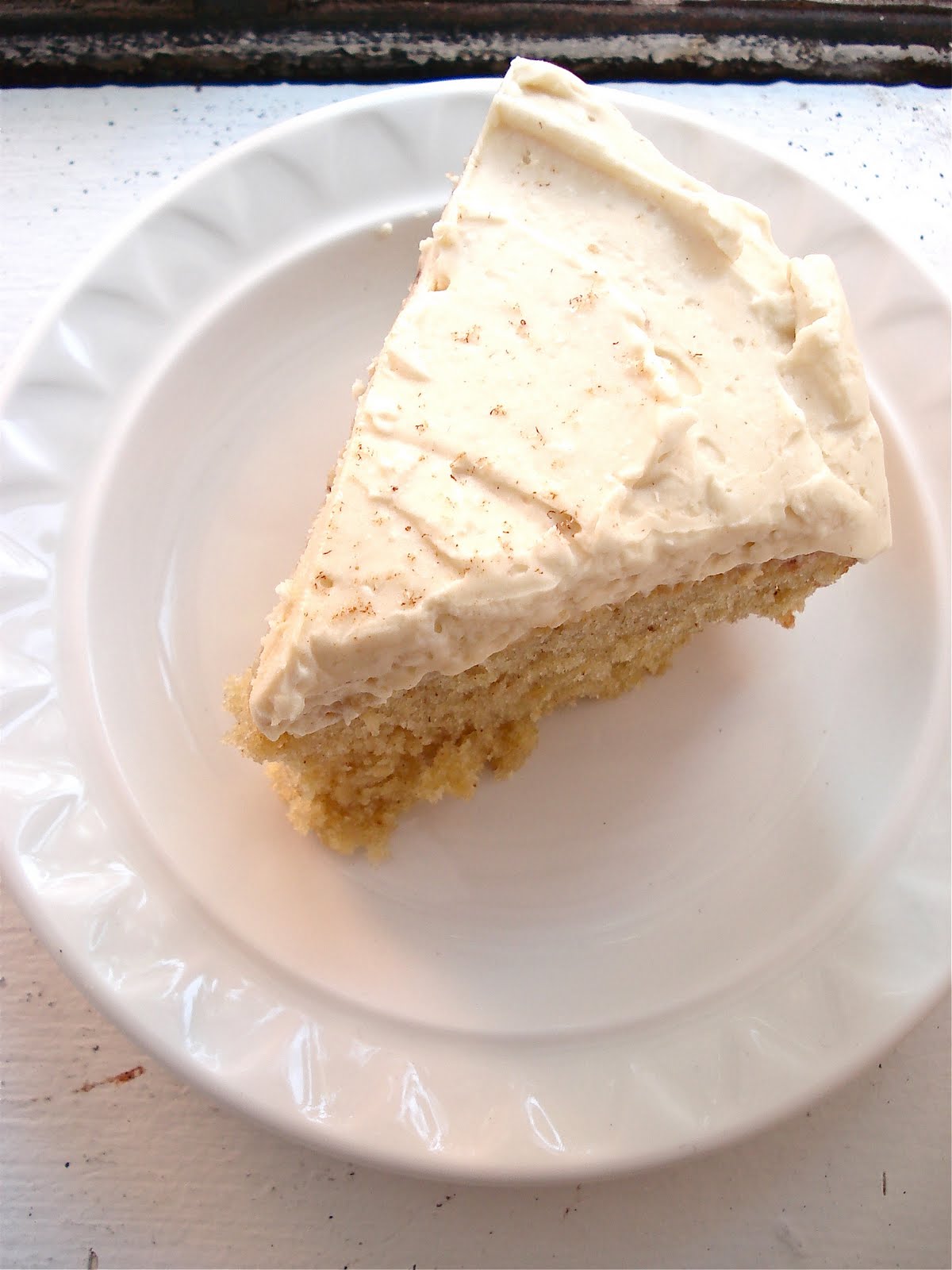
On a more successful dessert fête, my friends’ engagement party on my patio featured a buffet of homemade ice cream, paired with a number of fizzy alcoholic beverages for an adult ice cream float fest that would have made Bacchus proud. And there was cake. Specifically, nutmeg spice cake with a rum meringue buttercream.

While cocktails + ice cream is good—and sometimes a necessity—booze with cake is better. This will forever be true for me. And it likely explains why I have such strong feelings about wedding cake. (Read: + open bar.)

I now sit with a leftover slice of cake and can’t help but think how mind-blowing it would be to wash it down with some brandy. The cake itself is like reincarnated eggnog. Each ethereal bite is a cakey reminder of the special occasion cocktail I hold near and dear to my heart.

With this dessert, two souls become one. It’s the perfect marriage of innocence and depravity, a fluffy, moist cake, wrapped in a meringue buttercream and tucked in with a nip of rum. It’s not overly showy, nor is it overly complex to create, but it’s a recipe worth hanging on to all the days of your life.

This cake is patient, this cake is kind. It does not envy, it does not boast, it is not proud. It is nutmeg and rum together, in arguably their finest hour.

So I, Emily, take you, nutmeg cake, to be my pastry partner. And with this fork, I thee eat.

Nutmeg Spice Cake with Rum Meringue Buttercream

Adapted from Joanne Chang's cookbook Flour: Spectacular Recipes from Boston's Flour Bakery + Cafe

1/4 cup unsalted butter, at room temperature
1/4 cup olive oil
1.5 cups sugar
1 tsp vanilla extract
3 eggs
2 cups flour
1 tsp baking powder
1/2 tsp baking soda
1-1/4 tsp nutmeg, freshly grated
1/4 tsp cinnamon
1/4 tsp cloves, freshly ground
1/4 tsp ginger
1/2 tsp kosher salt
1 cup buttermilk, at room temperature

Rum Meringue Buttercream
1.5 cups sugar
6 egg whites
1.5 cups unsalted butter, at room temperature
1 tsp vanilla extract
1/4 tsp kosher salt
4-8 tbsp dark rum (to taste)

Preheat oven to 350 degrees. Butter and flour two 8 inch cake pans (if making a layer cake) or one 9 inch pan. In a stand mixer with paddle attachment, beat butter and oil for about 1 minute. On medium speed, slowly add in sugar and vanilla and beat until light and fluffy (about 2 minutes). Add eggs one at a time and beat until well combined.

In a medium bowl, sift flour, baking powder, baking soda, spices and salt. Add about a third of this mixture to creamed mixture above and mix until just combined; add half buttermilk, mix briefly; scrape down sides of bowl to incorporate all of mixture. On low speed, add half of remaining flour mixture and then the remaining buttermilk. Add remaining flour mixture and mix until just combined. Pour into prepared cake pan(s).

Bake cake in the middle of your preheated oven for 30-40 minutes.

To make the buttercream, in a small heatproof bowl, whisk sugar and egg whites together. Place a small amount of water in a saucepan big enough to allow your bowl to fit in it. When the water is simmering, place the bowl with the sugar and egg whites over the water; ideally, the bowl should not be touching the simmering water. Whisk the mixture for 6-8 minutes or until the mixture is hot to the touch.

Pour mixture into the bowl of a stand mixer and whip on medium-high speed for 6-8 minutes, until it becomes a light, white meringue. Turn the speed down to low and add the butter at 2 inch chunks and mix for 2-3 minutes. If the mixture looks curdled it will eventually smooth out, you may need to beat it for a few more minutes.

Add vanilla, salt and 4 tbsp of the rum and whip for an additional 1-2 minutes. Taste and add additional rum until desired, whipping briefly to incorporate.

Frost cake. Dust with additional freshly grated nutmeg. Eat cake.

Serves 8-12 (this depends on the size of your slices and the amount of spirits you've consumed)

Notes:
-The buttercream can be refrigerated for a few days if you aren't using it immediately; out of the refrigerator, beat for about 10 minutes before frosting. (Frosting may separate, but it will come together again.)

-If you happen to have leftovers of this cake, it will freeze brilliantly (even frosted), allowing you to eat it at midnight should that tickle your fancy.

-This is the stuff dessert dreams are made of. Nutmeg is also said to be an aphrodisiac. I'm just sayin' ...

-Ironically, the pastry chef that came up with this dessert at Flour was making it for a friend's wedding.